

Foxtail Millet: Sustaining Life and Faith
Introduction
My name is Rikuto Tamaki, and I study the relationship between grains and human societies at the Tokyo University of Agriculture.
Since 2022, I have also been a member of Slow Food Ryukyus.
As someone from an indigenous Ryukyuan background, I feel a deep personal connection to the history of millet in these islands.
Millet in Early Ryukyuan Life
From the 8th to the 10th century, foxtail millet, wheat, and rice were already being cultivated across the Ryukyu Islands, forming the foundation of everyday life.
Archaeologists have unearthed many charred millet seeds, preserved in the soil for more than a thousand years. These carbonized seeds offer clear evidence of millet’s long-standing role as a staple food in the region.
The Ryukyu Kingdom and Staple Foods
When the Ryukyu Kingdom was established in 1429, millet, wheat, and rice remained the main sources of daily sustenance. Millet, in particular, occupied a central role—not only nutritionally but also culturally.
A New Crop Arrives: Sweet Potatoes
For centuries, grains sustained the islands.
But in 1597, a man from Miyako Island introduced sweet potatoes from Fujian Province, China.
Sweet potatoes thrived in poor soil, grew quickly, and endured typhoons, soon becoming a reliable food source.
This new crop enriched and transformed the food culture of the Ryukyus and became vital to people’s survival.
Millet as Tax: 266 Years of Burden
Between 1637 and 1903, islanders suffered under an extremely harsh poll tax system imposed by external authorities.
In the Miyako Islands, men were required to pay taxes in millet, while women paid with woven textiles such as Miyako jōfu.
This regional difference was significant.
In many other Ryukyu islands, people paid their taxes with rice and cloth.
However, the Miyako Islands have very limited freshwater resources, making large-scale rice cultivation impossible.
Because rice could not be grown reliably, millet became the essential grain for both survival and taxation.
Origins of Foxtail Millet
Foxtail millet is believed to have originated in the region spanning Afghanistan, Pakistan, and northwestern India.
Its wild ancestor is Setaria viridis (green foxtail), and the cultivated form is Setaria italica.
Over centuries, people selectively improved the wild plant, ultimately shaping the millet varieties we know today.
Millet Diversity in the Miyako Islands
Research conducted in the Miyako Islands has revealed a remarkable diversity of millet spike forms.
These varieties differ not only in appearance but also genetically, demonstrating the rich agricultural heritage preserved by local communities.
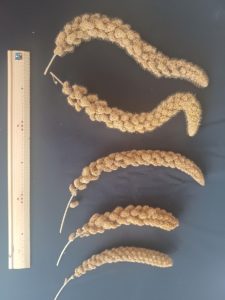
Millet spikes collected in Sarahama, Irabu Island
How Millet Is Grown
Millet cultivation follows the lunar calendar:
-
Sowing
Around the tenth lunar month, seeds are mixed with sand and scattered.
Farmers gently cover them with leaves or grass.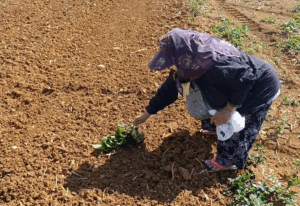
Sowing the seeds
-
Seedling Care
After about one month, seedlings sprout.
Farmers thin crowded plants, remove weeds, and take out insect-damaged stalks to protect healthy growth.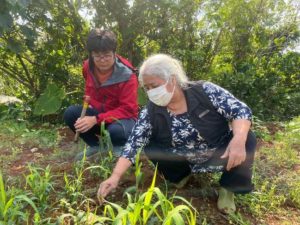
Weeding the field
-
Harvest
Harvest begins around the fourth lunar month and is done entirely by hand.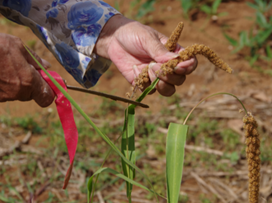
Hand-harvesting the millet
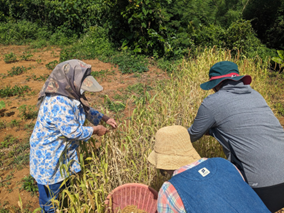
The millet harvest
-
Drying and Processing
The spikes are carried home in baskets, dried, and then threshed using coral stones or washboards.
Polishing was once done using wooden mortars but is now replaced by machinery.
Ntsugama: A Sacred Fermented Millet Drink
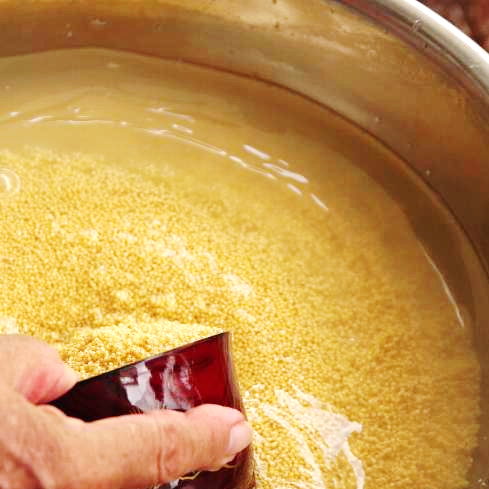
Millet is also used to make ntsugama, a traditional ritual drink.
How it is made:
-
Millet is blended and heated with water.
-
The mixture is strained for a smoother texture.
-
It is fermented in a container for two to three days.
-
To drink it, the fermented paste is dissolved in hot water.
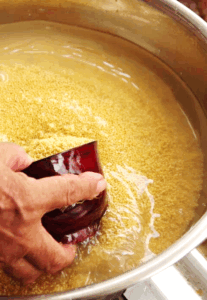
Ntsugama — a fermented drink offered to the gods during rituals
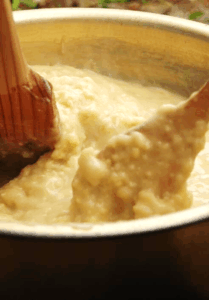
Ntsugama
Ābyūi: The Harvest Ritual
Ntsugama is indispensable to Ābyūi, a harvest ritual held around the sixth lunar month.
During this ceremony, people express gratitude for the year’s millet harvest and pray for abundance in the coming year.
The ritual reflects the deep spiritual connection between millet, land, and community.
The Song of Nnamatsutani
A traditional song called Nnamatsutani is sung during Ābyūi.
Its lyrics describe the entire journey of millet—from sowing the seeds to becoming the ritual drink.
The song acts as a bridge connecting farming practices and spiritual traditions, preserving both through oral transmission.
Seed Keepers: The Role of Elders
Ms. Nagasaki, a former Tsukasa (ritual leader), continues to grow millet today.
She holds certificates for two indigenous millet varieties registered in the Slow Food Ark of Taste in 2023.
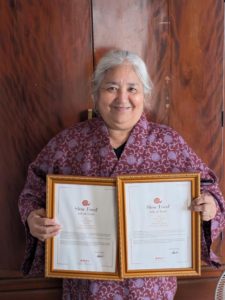
Ms Kunie Nagasaki
She says:
“Closing a ritual is easy, but reviving it is very difficult.
That is why we continue to preserve the seeds—for the future Tsukasa who will surely appear someday.”
Her words reflect the enduring wisdom and responsibility carried by seed keepers across generations.